Data Centers & “Garbage Wars”
Data centers seem to be the center of conversation for so many of us these days. While much of the conversation is centered on resource usage, there should also be a spotlight on e-waste. The rise in data centers is also increasing e-waste. Russ Ernst writes about the impending e-waste crisis in his article “Ticking Time Bomb: AI, Data Centers, and the Looming E-Waste Crisis.” But it might not have to.
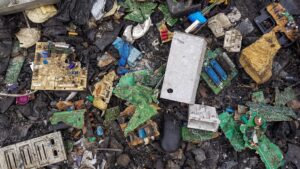 NCS Global has a great resource on developing sustainable data centers. The materials used in servers, switches, and hard drives contain trace amounts of toxic substances and create harmful waste. Environmental harm can be reduced when metals, plastics, and other materials are recycled at the end of their life. Read more about it in NCS Global’s “Sustainable Approaches to Data Center Decommissioning.”
E-waste isn’t the only thing on our mind. West Virginia continues to be a victim of other types of waste management industry, including nuclear waste. The passage of HB 208 in the fall of 2024 entered the state into an agreement with the United States Nuclear Regulatory Commission, allowing West Virginia to become a dumping ground for nuclear waste from other places. If that waste leaches into the air, water, or soil, it could cause serious health issues for those exposed. Saul Elbein wrote about the real consequences of nuclear waste exposure in his article, “Whistleblower Says Radioactive Fracking Waste Site Melted His Jaw. Now There’s an Elementary School There.”
Charleston Gazette-Mail
“WV House passes data center enticement bill that would keep project details hidden”
In a 78-16 vote, the House passed a legislative package that would allow data center developers to protect information like projected water usage from public eyes during the development process. Mike Tony reports more on the lengthy House floor debate before voting and what the proposed rule means for data center projects in the state.
“Morrisey administration undermining water protections in data center, selenium rules”
On Monday, dozens from around the state gathered at the Capitol to rally for clean water justice in the coalfields. Governor Morrisey announced funding from the DEP’s Office of Abandoned Mine Lands and Reclamation (AMLER) for critical water infrastructure projects in McDowell and Mingo counties. From Below: Rising Together for Coalfield Justice has cited a funding need
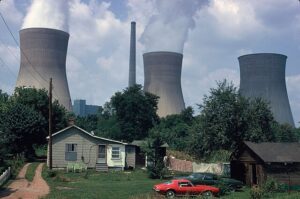
The John Amos Power Plant is owned and operated by American Electric Power (AEP) in Putnam and Mason counties. Harry Schaefer, Poca, West Virginia, August 1973
much larger than the roughly $10 million announced through AMLER. Read more from Mike Tony about the administration’s leadership regarding water during this legislative session.
“WV lawmakers look to control power bills but stand by Trump’s coal plant double-down”
Despite years of scientific evidence to the contrary, President Trump praised coal as a clean and cost-effective energy source during a White House gathering last week. The Department of Energy announced a nearly $200 million investment in coal-fired power plants around the country, including in West Virginia. Mike Tony explains more in “WV lawmakers look to control power bills but stand by Trump’s coal plant double-down.”
“AEP plan forecasts long environmental recovery to come for Wyoming County oil spill”
American Power says thousands of gallons of oil and water were spilled into Reedy Branch as a result of an equipment failure at a Wyoming County substation. The recovery plan is projected to take months. Mike Tony reported more details in “AEP plan forecasts long environmental recovery to come for Wyoming County oil spill.”
Mountain State Spotlight
“Coal Communities Accuse Congress of Breaking Its Promise to Clean Up Abandoned Mine Lands”
The US House of Representatives passed an appropriations bill that would pull $500 million in funding allocated for abandoned mine cleanup projects. Appalachian Voices reports that Kentucky and West Virginia would be among a group of states that could lose the most. Kiley Bense reports more details on the situation in “Coal Communities Accuse Congress of Breaking Its Promise to Clean Up Abandoned Mine Lands.”
West Virginia Watch
“Not good economic growth’: Residents call for protections against proposed data centers in WV”
West Virginians gathered at the Capitol yesterday to fight back against the lack of oversight and other protections in place for data center development. Since the passage of HB 2014 last year, counties all over the state are fighting against developers who want to place data centers next to residents’ homes, schools, and workplaces — all without much of any financial incentive for these communities. Caity Coyne reported more details in “Not good economic growth’: Residents call for protections against proposed data centers in WV.”
“Climate, health groups challenge EPA repeal of major greenhouse gas regulation”
Last week, the EPA repealed an Obama-era finding that helped create a framework to regulate greenhouse gas emissions. This repeal would have devastating consequences on the ability to reduce emissions in the fight against climate change. Jacob Fischler wrote about the groups working to fight back against this repeal.
State lawmakers voted down amendments that would have improved transparency during the data center development process. Delegate Laura Kimble, a Republican representing Harrison County, spoke against passing HB 4983 without additional provisions for transparency and oversight. Caity Coyne explains more about the scene on the House floor last week in “WV House passes new data center development rules without local control, water protection provisions.”
Politico
‘The Industry Comes In and Kills the Work of Local Citizens’
Communities around the country are working to stop the alarming rate of data center development near their homes. West Virginians know the sting of betrayal from state and federal governments doing little to help local organizing in this fight. Ariel Wittenberg reports on the fight happening in Prince William County, Virginia, in “The Industry Comes In and Kills the Work of Local Citizens.”