Lucia Valentine, WVEC lobbyist, works on her computer from the gallery while listening to legislators below. Photographed by Perry Bennett for the WV Legislature.
This Week at the Capitol
March 4 (Day 50) was Crossover Day, the last day for bills to make it out of their chamber of origin.
With Crossover Day behind us, we now have a narrowed focus on which bills are still “alive” and which bills are no longer viable this session.
With only one week remaining in the 2026 legislative session, the pace at the Capitol has accelerated considerably, with several major policy bills still moving that require close attention during the final stretch.
Below is a summary of where things stand.
WVEC Legislative Bill Status Summary – Bills Still Moving
Water Bills
HB 4983 – Data Center Rules
The Department of Commerce rule package was taken up by the Senate Judiciary Committee on Thursday, March 5. During the meeting, the Department of Commerce offered a committee substitute that included an important change to the definition of “inordinate burden.”
The revised language now states that an inordinate burden exists when a parcel’s use or access to water is so severely restricted that it deprives the owner of nearly all economically beneficial use of the property.
This addition is significant. Water use has been one of the primary concerns raised by WVEC and partner organizations as West Virginia pursues large-scale data center development. Including water access in the definition provides the Department of Commerce with clearer authority to consider water availability and impacts when evaluating data center projects. The committee substitute passed unanimously and will continue its legislative journey.
While discussions continue in the halls of the Capitol around local control, tax distribution, and citing issues, those concerns remain unaddressed. .
WVEC would like to thank Jennie Smith, Executive Director of WV Rivers, for her extensive work with the Department of Commerce on the microgrid intake form—the application that developers must complete when proposing a data center project. That work is helping ensure stronger review of water impacts, as seen by the Dept. of Commerce’s committee substitute, and other infrastructure considerations as these projects move forward. We will continue to keep you updated as those discussions progress.
SB 641 – Aboveground Storage Tank Bill
More than a decade after the 2014 Elk River chemical spill left 300,000 West Virginians without safe drinking water, the Legislature continues to debate whether the protections put in place after that crisis should remain strong or be weakened.
Members of the WVEC lobby team were in the Senate gallery during debate on SB 641, legislation that the oil and gas industry has pushed for several years to weaken protections for tanks located closest to our drinking water sources.
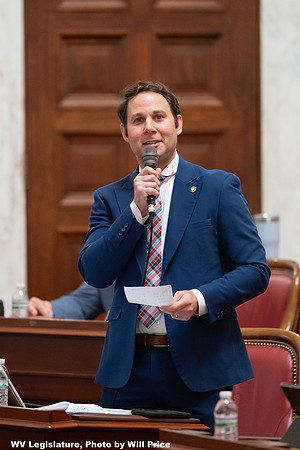
Senator Garcia advocates for an amendment clarifying tank exemptions would only be for tanks containing brine water. Photographed by Will Price for the WV Legislature.
Gas industry lobbyists distributed a “fact sheet” to Senators arguing that the tanks covered by the bill primarily contain brine water. During floor debate, Senator Joey Garcia offered an amendment that would have clarified that any regulatory exemptions would apply only to tanks containing brine water to reflect the false claims. The amendment was intended to ensure that tanks holding potentially hazardous materials—such as crude oil or other contaminants—would remain subject to appropriate inspection and oversight.
As the lead sponsor of the bill and chair of the Senate Energy, Industry, and Mining Committee, Senator Chris Rose was responsible for presenting and defending the legislation. During debate over Senator Garcia’s amendment, Senator Rose urged colleagues to reject the amendment and, in doing so, made statements on the Senate floor criticizing Scott Mandirola, a former state official who has testified on the issue and now works with WV Rivers.
Senators Garcia and Senator Woelfel responded to those remarks by defending the integrity of Scott’s testimony previously provided to the Legislature.
The amendment ultimately failed, though it received support from Senators Clements, Hamilton, Weld, Woelfel, Oliverio, and Garcia.
SB 641 ultimately passed the Senate by a vote of 24–9, with one member absent.
WVEC would like to thank the Senators who voted against the bill and stood up for the protection of West Virginia’s drinking water, including: Bartlett, Clements, Garcia, Hamilton, Oliverio, Roberts, Takubo, Weld, and Woelfel.
The bill has now been referred to the House Energy Committee, where it will receive further consideration. WVEC and our partners will continue working to ensure that the protections remain.
SCR 3 – Flood Resiliency Study Resolution
Pending in Senate Finance. Study resolutions are not subject to crossover deadlines. WVEC continues pushing for this resolution so the Legislature can develop long‑term funding strategies for flood resiliency planning and implementation.
SB 390 – SENTRY Flood Monitoring Funding
Passed the Senate and is now pending in House committees. This bill supports the SENTRY flood monitoring system aimed at providing earlier flood warnings and better data for communities.
Public Lands Bills
SB 894 and HB 5364 – Public Lands Corporation / Flatwater Trails Commission Reorganization
These bills reorganize the Public Lands Corporation and Flatwater Trails Commission and have support from the Governor and legislative leadership. Discussions continue regarding differences between the House and Senate versions.
HB 686 – Coal Co‑Tenancy Bill
This bill would allow coal companies to begin longwall mining operations with 75% approval from co‑tenants who share ownership of the coal estate. The WV Surface Owners’ Rights Organization is actively opposing the bill.
HB 4126 – State Park Endowment Fund
Passed the House and will be on third reading in the Senate on Monday, 3/9. The proposal would create a long‑term endowment fund to support maintenance and improvements across the state park system.
Budget & Appropriation Bills
SB 250
Budget bill passed by House and Senate. It includes $5 million in surplus funding for the Flood Resiliency Trust Fund. It is on the Governor’s desk for signature or veto.
SB 818 – Supplemental Flood Resiliency Funding
Pending in Senate Finance.
HB 5296 – $10 Million Flood Resiliency Fund Appropriation
Pending in House Finance.
Straight Pipes Funding – Budget Proposal
House Finance Chairman Vernon Criss continues advocating for $30 million to eliminate straight pipes across West Virginia. This remains one of the most significant rural water quality and public health challenges in the state.
Bills That Are Dead
The following bills did not advance out of committee before crossover deadlines and are effectively dead for the session unless revived through unusual procedures.
SB 88 – Community Air Monitoring Bill
SB 475- Anti‑Science Bill
SB 708 – WV River Access & Bridge Modernization Act
SB 501 – Digital Mapping of Unimproved Public Roads
SB 753 – Adopt‑a‑Road
SB 770 – Off‑Highway Motor Vehicle Recreation Act
SB 777 – Outdoor West Virginians with Disabilities Act
HB 5468 – Ratepayer Bill of Rights
HB 5525 – Southern West Virginia Clean Water Fund
HB 5646 – State Resiliency & Flood Protection Act
HB 5210 / SB 762 – Governor’s Water Infrastructure Bill
Note on HB 5525 – Southern WV Clean Water Fund
Although technically dead due to the committee deadline, this bill created considerable conversation on the House floor.
Delegate Vance attempted to suspend the rules to move the bill forward and send it to the Senate. The motion narrowly failed. The bill remained on Second Reading on the House floor, demonstrating how fluid legislative procedure can become during the final days of session.
Looking Ahead
With only a handful of days remaining in the session, much of the remaining action will center around the state budget, late‑moving policy bills, and potential amendments to active legislation.
WVEC will continue advocating for policies that protect clean water, healthy communities, public lands, and long‑term economic sustainability.
If you have questions about any of the issues above or would like to get involved, please contact the WVEC lobby team: Lucia and/or Kasey.