
Nearly four decades later, West Virginia still grapples with the same issues
By Anna N. Saab
Nearly four decades ago, in 1990, hundreds of West Virginians gathered at the Capitol to rally for the environment. Today, many of their struggles are our struggles, including groundwater protection and waste disposal.
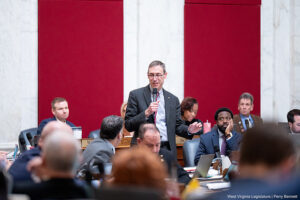
Delegate Evan Hansen (D-Monongalia) addresses the floor before a vote on his proposed amendment to HB 4983. Photographed by Perry Bennett for the West Virginia Legislature.
Just this week, state lawmakers once again rejected an amendment that would require data center developers to disclose information about where water would be sourced, where it would be used, and who it might impact. Delegate Evan Hansen, who proposed one of two amendments, said, “In my opinion, water is the state’s most precious resource. This is something we can do to make sure it’s protected for future generations while also allowing for economic development.”
In 1991, the Legislature passed the West Virginia Groundwater Protection Act, requiring the Department of Environmental Protection (DEP) to develop quality and purity standards for groundwater. More than half of West Virginians rely on groundwater for drinking water, particularly in rural parts of the state. The policy created a foundation for groundwater management and preservation.
Decades later, drinking water supplies continue to be at risk of contamination for the sake of economic development. Now the new industry player is data center development. Then, as now, industry leaders maintain a stronghold over policy development.
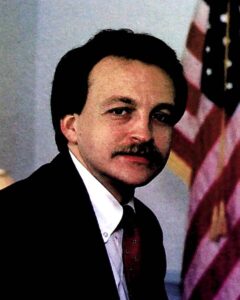
Caption: Chuck Chambers served as West Virginia House Speaker from 1986 to 1996, and was later nominated to a seat on the United States District Court for the Southern District of West Virginia by President Bill Clinton.
Former WVEC board member Mary Wimmer, Ph.D. wrote about the development of groundwater protection legislation in her piece for Now & Then: The Appalachian Magazine — a magazine previously published out of the Center for Appalachian Studies and Services at Tennessee State University when she published her article “Birth of a Citizen Coalition: West Virginia’s Environmental Council” in the spring of 1995. In 1989 and 1990, WVEC activists tried to pass more progressive groundwater protection with the help of House Speaker Chuck Chambers, a Democrat from Huntington.
“The bill’s main feature was the ‘non-degradation’ clause,” she explained, “This clause stipulated that West Virginia’s existing groundwater quality would be maintained, even if that quality actually surpassed what was necessary to provide safe drinking water. In contrast, industry wanted to allow groundwater pollution as long as the level of pollutants met standards that supposedly protect beneficial uses.”
The bill also included a provision that would enable a person to sue another for polluting their groundwater; Something Wimmer says industry couldn’t abide by.
“The opposing forces — primarily coal, natural gas, chemical, and agricultural businesses and their trade groups — beat our legislation back repeatedly, but we kept making slow progress,” she continued.
In the final minutes of the 1990 legislative session, changes were made to remove these clauses — changes made by industry-backed legislators. With these changes, advocates and Chambers killed the bill. What’s a groundwater protection act without citizen recourse for polluted groundwater?
36 years later, elected and appointed state leaders have continued to fail the public. The interests of data center developers have seemingly taken priority over protecting West Virginians. Common-sense amendments are struck down as unnecessary despite an outpouring of support from constituents and bipartisan efforts.
Data center developers aren’t the only ones eyeing the state for opportunity — other experimental industries are trying to make headway in West Virginia. Companies often see large swaths of land and a historically disenfranchised population present an opportunity for development with lesser-known impacts.
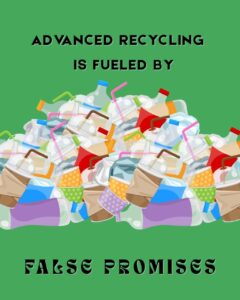 A company has proposed building an advanced recycling plant in Belle, WV. At first glance, advanced recycling might seem like a great solution to plastic pollution. However, the process creates high amounts of toxic emissions and requires lots of energy. It poses a serious risk to clean air and water, compromising the health and safety of surrounding communities. In effect, advanced recycling could turn Belle into a receptacle for the country’s plastic waste. WVEC Vice President Morgan King has been fighting alongside the people of Belle.
During the 80’s and 90’s, residents in Wetzel County fought the development of a massive waste dump where thousands of tons of waste would be imported and disposed of. The group known as Halt Out-of-State Garbage (HOG) was led by Martha Huffman. Through successful grassroots organizing, the movement spread quickly. Extractive industry leaders stood to gain so much profit at the massive demise of state resources, infrastructure, and residents.
“Monstrous landfills for out-of-state waste would generate huge profits for the dump owners. Meanwhile, landfill leachate would threaten the quality of the state’s ground and surface waters. West Virginia’s mountain topography would be destroyed as its valleys and streams were filled,” explained Wimmer, “ Its roads, which were not designed for huge haul trucks, would rapidly deteriorate. Finally, these massive landfills would promote a very common “out-of-sight and out-of-mind” mentality, undermining efforts at recycling, biodegradation, and conservation so badly needed nationwide.”
In the end, the hard work of grassroots organizing paid off.
“With pressure from the Coalition, the West Virginia Legislature passed some of the most progressive and comprehensive legislation on rural solid waste management in the nation,” Wimmer wrote, “Two of the most important pieces of legislation passed were the 1990 Solid Waste Referendum and the 1991 Comprehensive Solid Waste Acts.
The garbage wars didn’t end with the passage of that legislation. The new age fight against dumping in West Virginia concerns nuclear and plastic waste. Advanced recycling is just one example. Just up the road from Charleston, Parkersburg hosts a radioactive waste dump for the Department of Energy. Communities in our state continue to fall victim to the space-hungry waste management industry. Although the types of waste change, the fight remains the same. West Virginia is rich in resources for the evolving forms of extractive industry in the United States.
In 2026, we hope to continue to advocate as effectively as our predecessors. The shadow of industry looms large, but the power of community organizing still stands strong. As more than 30 organizations convene this coming E-Day, I hope we’re all reminded of just how powerful we can be when we work together.






Thank you Anna for this very informative article providing a retrospective look at environmental legislation and environmental advocacy in West Virginia. It’s important and inspiring to be reminded about the efforts and successes of WVEC members in years past, as well as efforts today, AND about how powerful we can be when we work together. Onward!
Thank you for the kind words, Sandra. Absolutely!